Beginner Workout Plan for Women: 3 Full-Body Days
A practical three-day beginner strength plan for women, with gym and no-equipment home options plus a simple progression method.
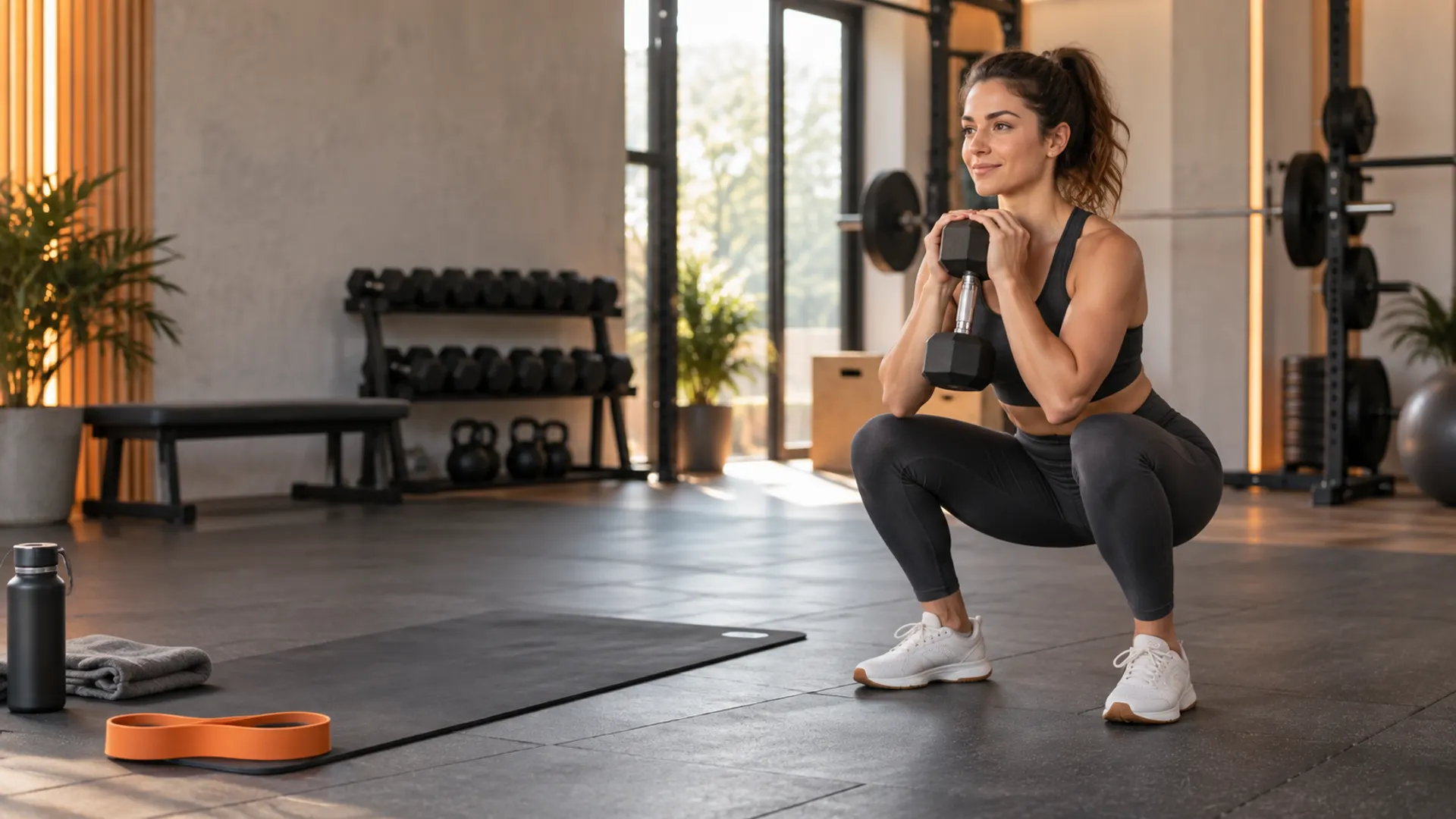
A good beginner workout plan for women trains the full body three times per week with simple movements and measurable progression. You can begin at a gym or at home without equipment. Leave at least one recovery day between sessions and choose a difficulty that leaves two or three good repetitions in reserve at the end of each set.
Why use a full-body workout plan for women?
A full-body routine lets you practice the major movement patterns several times each week without exhausting one muscle group in a single session. For beginners, that frequency supports skill development, confidence and steady progress. If you miss one workout, your whole week is not suddenly unbalanced.
You also spend less time learning a long list of isolation exercises. Each workout covers the lower body, pushing muscles, pulling muscles and core. This gives you a strong base before you decide whether a more specialized split matches your goals.
Strength training does not make women bulky by accident. Building a large amount of muscle takes years of progressive training, adequate food and deliberate effort. Most beginners notice improved strength, posture, movement control and muscle definition long before dramatic size changes.
Three-day beginner gym workout plan for women
Warm up for five to ten minutes, then perform a light preparation set before the first demanding exercise. The suggested rest periods are 90 seconds for larger compound movements and about 60 seconds for smaller or core exercises. Rest longer when you need it to maintain good form.
Workout A
| Exercise | Sets | Repetitions | Rest |
|---|---|---|---|
| Leg press | 3 | 8 to 12 | 90 sec |
| Seated cable row | 3 | 8 to 12 | 90 sec |
| Dumbbell chest press | 3 | 8 to 12 | 90 sec |
| Dumbbell Romanian deadlift | 2 | 10 to 12 | 90 sec |
| Front plank | 3 | 20 to 40 sec | 60 sec |
Workout B
| Exercise | Sets | Repetitions | Rest |
|---|---|---|---|
| Goblet squat | 3 | 8 to 12 | 90 sec |
| Lat pulldown | 3 | 8 to 12 | 90 sec |
| Hip thrust | 3 | 10 to 15 | 90 sec |
| Machine shoulder press | 2 | 8 to 12 | 75 sec |
| Dead bug | 3 | 6 to 10/side | 60 sec |
Workout C
| Exercise | Sets | Repetitions | Rest |
|---|---|---|---|
| Reverse lunge | 3 | 8 to 10/leg | 90 sec |
| One-arm dumbbell row | 3 | 8 to 12/side | 75 sec |
| Chest press machine | 3 | 8 to 12 | 90 sec |
| Leg curl | 2 | 10 to 15 | 75 sec |
| Farmer carry | 3 | 30 to 45 sec | 60 sec |
You could train on Monday, Wednesday and Friday. If three sessions do not fit your schedule, begin with two. Continue the sequence rather than assigning each workout permanently to one weekday: A and B during week one, C and A during week two.
Beginner home workout plan for women without equipment
Use a stable chair, a towel and an exercise mat if available. When a movement becomes easy, slow the lowering phase, add repetitions, pause in the hardest position or move to a more difficult variation.
| Workout | Exercises | Sets and repetitions |
|---|---|---|
| A | Chair squat, incline push-up, glute bridge, bird dog | 3 × 10-15; 3 × 6-12; 3 × 12-20; 3 × 8/side |
| B | Assisted reverse lunge, towel isometric row, hip hinge, side plank | 3 × 8/leg; 3 × 20-30 sec; 3 × 12-15; 3 × 15-30 sec/side |
| C | Split squat, wall push-up, single-leg bridge, dead bug | 3 × 8/leg; 3 × 8-15; 3 × 8/leg; 3 × 8/side |
For the isometric row, hold a strong towel in front of you and pull its ends apart while keeping your shoulders down. This does not perfectly replace a loaded pulling exercise. A resistance band or dumbbell will make back progression easier when you are ready to add equipment.
Adapt the plan to your level, available equipment and goal with the free CoachSportAI diagnosis. You also receive calorie and macro targets plus your first complete workout, with no card required.
How to progress week by week
Week 1: learn each movement
Choose the most stable variation and a conservative weight. Stop every set with roughly three possible repetitions in reserve. Record the exercise, weight and repetitions. Technique matters more than fatigue during the first week.
Week 2: add repetitions
Keep the same weight and add one repetition per set when the movement remains controlled. You do not need to progress every exercise in every workout. One or two improvements are enough.
Week 3: increase difficulty slightly
When you reach the top of the repetition range on all sets, add the smallest available amount of weight. At home, slow the lowering phase, pause at the bottom or choose a harder variation.
Week 4: consolidate
Repeat the previous week's weights and make the repetitions cleaner. If you are unusually tired or sore, remove one set from each exercise. Begin another four-week progression after recovery.
This approach is called double progression: first you build repetitions inside a range, then you increase the load and return to the bottom of that range. It is simple enough for a beginner and precise enough to work for months.
Beginner workout plan for women and weight loss
The strength program does not need to change completely when your goal is fat loss. Resistance training helps maintain or build muscle while nutrition creates most of the energy deficit. Add regular walking and, if you enjoy it, one or two short cardio sessions.
Use our guide to calculate calories and macros. Avoid combining a severe diet with a sudden large increase in training volume. That combination often creates fatigue before it creates a sustainable routine.
Turn general advice into your diagnosis
Answer the questionnaire and get your diagnosis plus your first complete workout for free, with no card required. You can then decide whether to unlock the rest of the plan.
Get my free diagnosisTrack more than scale weight. Waist measurements, photographs under consistent conditions, gym performance and how clothes fit can show progress that a single weigh-in hides.
A workout plan for women who want to get toned
Getting toned usually means losing some body fat while maintaining or building muscle. No exercise selectively burns fat from the stomach, hips or thighs. Train your whole body, become stronger and let your nutrition influence the overall fat-loss trend.
High repetitions are not automatically better for definition. Sets of 8 to 15 repetitions are practical for many exercises, but the key is that the last repetitions require effort while technique remains sound.
How to choose your starting weights
The final repetition should feel challenging without changing the movement. If you exceed the top of the range easily, increase the weight slightly. If you cannot reach the minimum or your posture changes significantly, reduce it.
Do not compare your starting weight with another person's. Machine design, limb length and training history all change the number. The correct weight is the one that lets you perform the prescribed repetitions with control and progress from your own baseline.
Sharp joint pain is not a useful training signal. Stop the movement and ask a qualified professional for guidance. If you are pregnant, injured or managing a medical condition, have your activity reviewed by a healthcare professional.
Essential technique cues
During a squat, keep your feet stable, let your knees follow the direction of your toes and descend only as far as you can control. During a hip hinge, move your hips backward with a neutral spine instead of turning it into a squat. During pushes and pulls, keep your shoulders away from your ears.
Breathe before the repetition, create tension through your trunk and exhale after the hardest portion. Film one set from the side if you want to review the movement. A short video often gives better feedback than a mirror, which encourages you to turn your head and change position.
What if you miss a workout?
Do not double the next session. Continue where you stopped. If you repeatedly miss Friday, place your two priority sessions earlier in the week and treat the third as optional until your schedule becomes more predictable.
One imperfect week does not erase progress. A program that is too ambitious can create repeated restarts. Two workouts completed for three months are more valuable than three workouts completed for ten days.
Recovery and muscle soreness
Soreness does not measure workout quality. It is common when you begin or introduce a new movement, then often decreases as your body adapts. Easy walking, regular sleep and adequate food are more useful than trying to destroy soreness with another hard session.
If one area remains painful, adapt or replace the movement. Learn to distinguish normal muscular effort and temporary burning from sharp or joint pain. Stop for the latter and seek professional advice if it persists.
When should you change the program?
Keep this foundation for six to eight weeks if you are progressing and the exercises remain comfortable. Change a variation when it causes discomfort, equipment is unavailable or progress has stopped despite adequate recovery.
Do not replace every movement at once. Preserve comparable markers and swap within the same movement family: leg press for goblet squat, cable row for band row, or machine press for incline push-ups.
Signs of a productive training week
- Two or three sessions completed with recovery between them.
- At least one recorded improvement, even a small one.
- A reasonably consistent sleep routine.
- Protein included across the day.
- No need to train to failure on every set.
- Stable technique before additional weight.
You can also learn how an AI fitness coach personalizes training. If your nutrition goal changes, use the guide on whether to bulk or cut first.
FAQ
What is the best beginner workout plan for women?
Start with a full-body routine two or three times per week. It should include legs, hips, a push, a pull and core work using exercises you can perform safely.
How long should a beginner workout last?
About 45 to 60 minutes is enough for most beginners, including a warm-up. The quality of the working sets matters more than staying in the gym for a specific duration.
Can women start strength training at home without equipment?
Yes. Bodyweight variations help you learn movement and build a routine. A resistance band or a few dumbbells will later make gradual progression easier.
Is a home or gym workout better for women?
Choose the setting where you can be consistent. A gym provides more loading options, while home training removes travel and can be easier to fit into a busy day.
How much rest should I leave between full-body workouts?
Ideally leave at least one day without full-body strength training between sessions. Walking and gentle mobility work are still possible on those days.
Does strength training make women gain weight?
Scale weight can change with water and stored carbohydrate before muscle or fat changes become visible. Follow measurements, photographs and performance as well as body weight.
Get your free diagnosis and first complete workout, with no card required. If you want the full plan, it unlocks through a one-time payment with no subscription, and the PDF is included.
Get your personalized starting point
Answer the questionnaire and get your diagnosis plus your first complete workout for free, with no card required. You can then decide whether to unlock the rest of the plan.
Get my free diagnosisTags
Related articles
How to Know Your Body Type: Ectomorph or Endomorph?
Ectomorph, mesomorph or endomorph? Use practical clues, then adjust your training and nutrition without letting a label define you.
AI Sports Program Generator: Personalized Workout Plans in 60 Seconds
Discover how CoachSportAI is revolutionizing sports coaching with personalized programs generated in 60 seconds! 💪